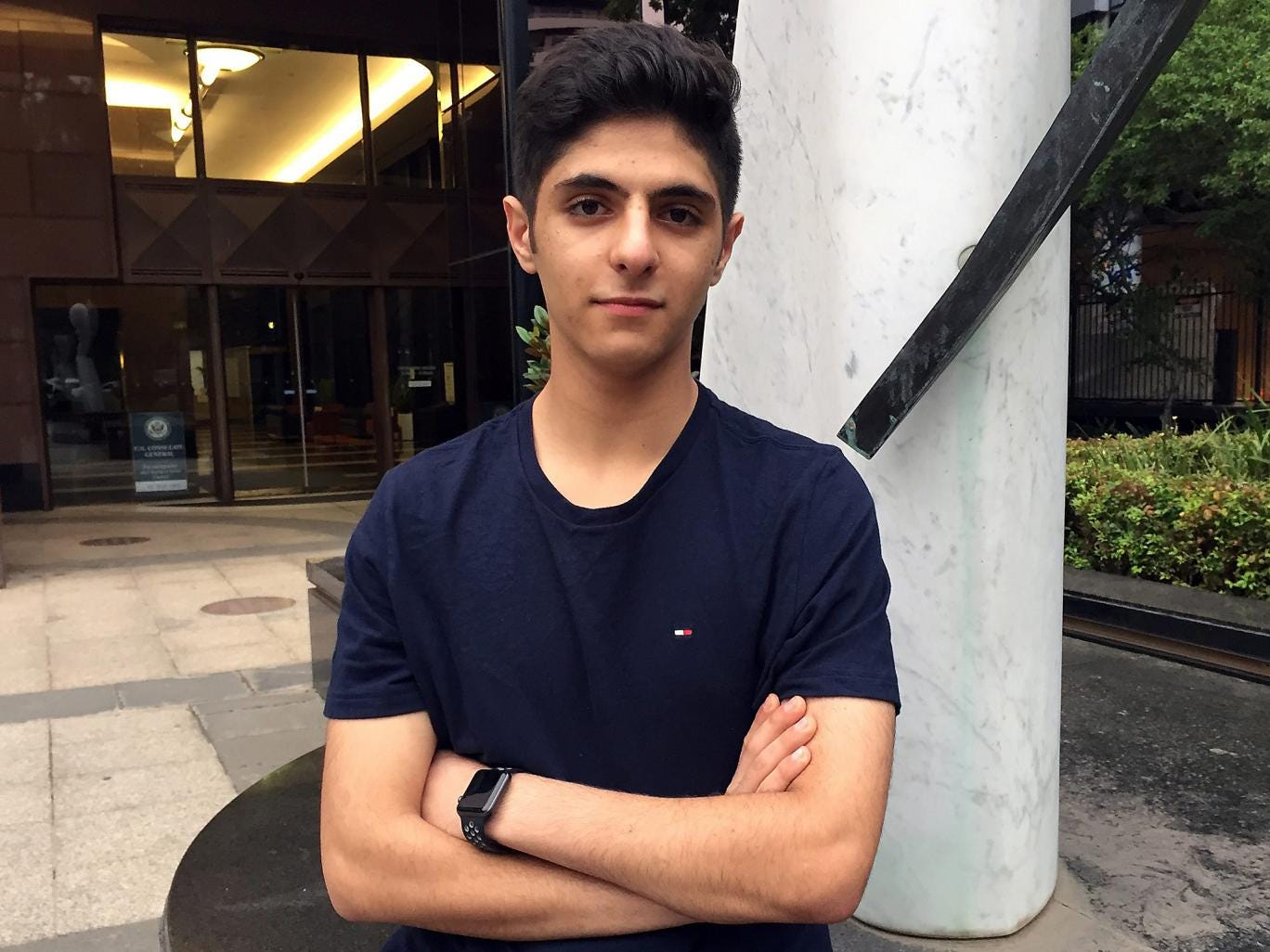
A teenager denied a visa to go to space camp in the US because of Donald Trump’s travel ban has been told he should be allowed to go after all.
PouyaGhadirian, 15, thought his dream trip was over when the American Consulate in Australia said they could not grant him a visa because of his dual Australian-Iranian passport.
But Prime Minister Malcom Turnbull has said this was a mistake and that Australian dual nationals should not be affected by the highly controversial ban of residents from seven Muslim-majority countries including Iran.
Mr Ghadirian planned to visit the US with classmates in March, with the trip set to include Orlando, Washington DC and the Space and Rocket Centre in Alabama.
The Melbourne teenager cried with disappointment when he was told during his visa interview that he couldn’t proceed with his application after Mr Trump signed an executive order banning entry from seven predominantly Muslim countries -Syria, Lybia, Iraq, Iran, Yemen, Somalia, and Sudan.
“I cried at the consulate and I don’t normally,” Pouya told The Sydney Morning Herald. “My dad was upset as well because he was saying, 'Look we've had no criminal record and we've done nothing wrong.'"
He said: “I can’t really tell (if I’ll be allowed to go) until I go to the consulate again. As of now we still haven't received any information from the US consulate, or the embassy, or the foreign ministry."
He added that he thought it was “unbelievable” that Iran was added to the list of countries.
“There are a lot of successful Iranian people in the United States that have contributed to the economy and made America what it is,” he said.
Mr Ghadirian's parents have lived in Australia for nearly 20 years and he was born there, but deemed ineligible for the US visa waiver programme, which allows Australian citizens to stay in the country for 90 days without obtaining a visa.
After Mr Trump’s order was announced, Mr Turnbull instructed Australian diplomats to secure exemptions like those granted to British and Canadian citizens.
There are more than 110,000 Australian residents who hold dual passports with one of the seven banned countries.
The Australian Prime Minister has been criticised in much the same way as Theresa May in the UK for his failure to condemn the travel restrictions outright.
Mr Turnbull said: ”When I have frank advice to give to an American president, I give it in private as good friends do — as wise Prime Ministers do to ensure they are best able to protect Australia and Australia's best interests.“
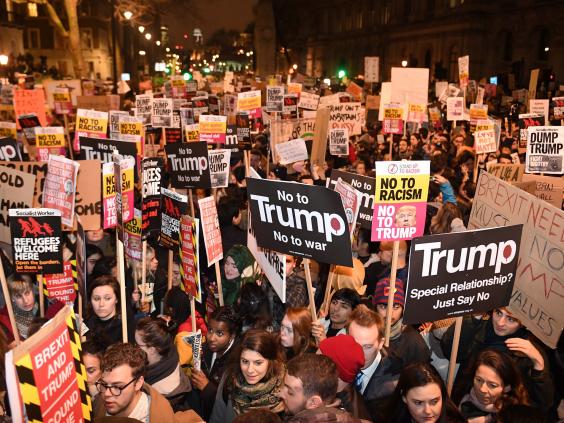
Confusion, chaos and anger have spread throughout the world since the executive order was abruptly announced, with those holding dual passports with one of the banned countries left unsure of whether or not they can enter the US.
Foreign Secretary Boris Johnson said he has obtained assurances that British citizens with dual passports should not be denied entry.
A few months ago, United Kingdoms decided to make a referendum in order to stay or not in the European Union. But what will be the impact on the British Economy ?
Daylimail tries to clafiry this question.
OMING late in Handel’s “Messiah,” the glittering instrumental solo in “The Trumpet Shall Sound” is one of the most recognizable trumpet parts in music. This time of year, its rousing opening fanfare and serenely gleaming lyrical passages can be heard in concert halls and churches all over the country, part of a bass aria that becomes one of this beloved oratorio’s emotional highlights, charged with hope, mystery and awe.
Awe is also the overriding emotion that musicians bring to the part — especially when they perform it on the Baroque trumpet. John Thiessen, one of the most consistently outstanding performers on period trumpets, who is currently playing the solo in Trinity Wall Street’s “Messiah” performances, said in an interview that while the writing is not especially virtuosic, the part is extensive and exposed: “You have to be ready and you have to be prepared physically.”
These days, the solo is most commonly played on a modern piccolo trumpet, a small, tightly coiled instrument — with two feet of tubing to the Baroque trumpet’s seven — that produces an incisive, citrusy-bright sound. The more sweetly toned Baroque version, by contrast, is long and straight — and, most important, devoid of the valves that on modern instruments enable players to hit and evenly tune all the notes of a scale.
Photo
The musician John Thiessen, who is known for his performances on period trumpets.CreditAlex Welsh for The New York Times
The resulting instability of intonation was so much of an issue, even in Handel’s time, that a music historian of that era, Charles Burney, complained that certain notes on the trumpet were “too much used for even vulgar ears to bear patiently.”
Like most of today’s period trumpeters, Mr. Thiessen plays on modern copies of Baroque instruments to which holes have been added to improve intonation. But in a brass player’s equivalent of scaling Everest without oxygen, some trumpeters take pride in playing — and meticulously tuning — Handel’s solo on so-called natural trumpets without holes. When the British trumpeter Crispian Steele-Perkins recorded it that way in the late 1980s, he asked Mr. Thiessen, who was then studying with him, to accompany him to the recording studio as a witness.
In a phone interview, Mr. Steele-Perkins said that one of the reasons performers struggle with the solo on period instruments is that they tend to take a gladiatorial louder-is-better approach that ill suits the music of the time. “The main reason for disasters in performance nowadays is that young players do not understand that in the 17th and 18th centuries, the art of trumpet playing was not how loud you could play but how quietly,” he said. “There are many written commentaries from the time, which express amazement that a militaristic instrument can be sounded with such delicacy.”
In “The Trumpet Shall Sound,” Mr. Thiessen said, the more transparent sound of a Baroque instrument allows the musician to move “more easily from being a soloist to an ensemble player as the situation changes.” His own interpretations of the part stand out for the singing smoothness that he brings to the high scales that wind in and out of the vocal part.
But it is the opening fanfare, a dotted rising arpeggio, that is most identified with the aria’s promise of resurrection. Pulling out a copy of the manuscript score, Mr. Thiessen pointed to a correction Handel made to the number’s tempo. Crossing out “Andante” (literally, in Italian, “walking”) — in the phrase “Andante ma non allegro,” the composer changed the marking to “Pomposo ma non allegro,” indicating a statelier but energetic gait.
Photo
Long and uncoiled: specialty trumpets owned by the musician John Thiessen.CreditAlex Welsh for The New York Times
Mr. Steele-Perkins discovered just how specific the ceremonial connotations of that trumpet opening would have been to contemporary ears when he bought a pair of trumpets that had been in the possession of the assize court in the English town of Guildford. Inside the case was a piece of music manuscript paper containing the flourish to be played at the arrival of the judge. It turned out to be an exact match of the opening three bars of Handel’s aria.
“This would have been immediately recognized by English and Irish audiences at the time,” Mr. Steele-Perkins said. “The arrival of the judge here becomes the Day of Judgment — an important testament to Handel’s faith and a climactic moment in the oratorio.”
The text of the aria is taken from Paul’s First Epistle to the Corinthians: “The trumpet shall sound and the dead shall be raised incorruptible, and we shall be changed.” In typical fashion, Handel uses word painting to reinforce the message, sending the vocal part through elaborate undulating runs on the word “changed.”
“The message in the text is about hope,” Mr. Thiessen said. After the oratorio’s first part, devoted to the prophecy of redemption, and the second, dealing with suffering, sacrifice and folly, the third part is about victory over death and war.
“In ‘The Trumpet Shall Sound,’ I am the angel,” Mr. Thiessen said, adding that in Handel’s music, the trumpet often represents a different plane of existence from the rest of the orchestra: the regal, the divine or the military. “Every time Handel uses the trumpet, it’s on the side of what’s right,” he said. “If the king is a good king, it’s representing the king. But in the case of ‘Saul,’ the trumpet is never played for Saul, the king — it’s played for David, who’s 8 years old.”
Bach, by contrast, sometimes “sets up the trumpet to fail,” Mr. Thiessen said. “In the arias where he talks about the difficulties and troubles of life, he’ll give the trumpet something really difficult to play, to set him up to fail. It has to sound hard.”
For Baroque trumpeters, the challenge in Handel’s “Messiah” is to radiate confidence even while negotiating the difficulties of the part. As for Burney’s complaint about tuning, Mr. Thiessen points out that the historian had worked as a violist in Handel’s orchestra and that it was very likely that he sat right in front of Valentine Snow, the trumpeter who inspired many of Handel’s solos. Easy on the ears it would not have been.
These days, he said, seasoned period-instrument conductors like Nicholas McGegan will instruct the string players to tweak their own intonation to match that of the trumpet in an aria such as Handel’s. But given that the trumpet represents a power outside of the orchestra community, it may be appropriate to emphasize its difference with its own tuning system, too. After all, as Mr. Thiessen said, “It’s music from a different world.”
The artist Duke Riley’s ice skating rink along the Malecón, part of the 12th Havana Biennial. CreditLisette Poole for The New York Times
1. 2015 Havana Biennial
This show coincided with prospects of a rapprochement between Cuba and the United States, and mixed-signals politics played a role in the event itself. When it opened in June, the Cuban-born artist Tania Bruguera was under the equivalent of house arrest in Havana for trying to do a performance piece that invited people to speak freely at an open microphone in Revolution Square. During the Biennial itself, another Cuban-born artist, María Magdalena Campos-Pons, working with a group of her American students, quietly presented Cubans with a similar opportunity to express themselves by writing in notebooks on questions about current events, including whether art could contribute to cross-cultural conversations. The focused and passionate responses of the writers said yes. There was no government interference.
David Salle’s “Splinter Man,” on a background print of Donald Moffett’s “He Kills Me,” part of the first exhibition at the new home of the Whitney Museum of American Art.CreditTony Cenicola/The New York Times
2. The Whitney
The opening of the Whitney Museum of American Art’s new plant in themeatpacking district was the local museum event of the year. Everyone cheered the Renzo Piano building; many had praise for the permanent-collection show, “America Is Hard to See.” But with the confetti cleared, it’s apparent that the Whitney is still pretty much what it has always been, apart from a few years in the 1980s and 1990s: an institution often flat-footed in its programming and compromised by its narrow definition of “American.” It needs new thinking to match its new home.
“Love” (1962) by Marisol (Marisol Escobar), is part of “Transmissions: Art in Eastern Europe and Latin America, 1960-1980” at the Museum of Modern Art. CreditMarisol
3. MoMA
Though it still harps on its own peculiar version of Modernism, one that we know all too well, the Museum of Modern Art gave signs of expanding its scope. The exhibition “Transmissions: Art in Eastern Europe and Latin America 1960-1980” (through Jan. 3) brought little-seen work out of deep storage, examined it, and added to it. Much of the salvage operation was by in-house curators.In the fall, MoMA’s International Curatorial Institute, joined by the Center for CuratorialLeadership, hosted a conference of curators from museums in China, Greece, Nigeria, Palestine, Poland, Russia and Senegal. The visitors were in town to learn New York, but New York has everything to learn from them.
Noah Purifoy’s Outdoor Desert Art Museum, an outdoor environment of sculptures and assemblages in Joshua Tree, Calif. CreditStephanie Diani for The New York Times
4. Los Angeles
The city’s art scene continues to build, the promotional heat intensifying. The opening of the Broad in September was major West Coast news, though much of the collection is market boilerplate and East Coast-centric. More interesting was the city’s continuing attention to its own neglected history in “Noah Purifoy: Junk Dada” at the Los Angeles County Museum of Art (through Jan. 18), a retrospective of an African-American artist who was a founder of the Watts Tower Art Center and established an outdoor museum in theMojave Desert.
“Bus,” one of the works in “One-Way Ticket: Jacob Lawrence’s Migration Series and Other Visions of the Great Movement North” at the Museum of Modern Art.Credit2015 The Jacob and Gwendolyn Knight Lawrence Foundation, Seattle/ Artists Rights Society (ARS), New York, Collection of George Wein, Michael Rosenfeld Gallery LLC, New York, NY.
5. Outstanding Solos
The grave retrospective of the Colombian artist Doris Salcedo at the Guggenheim in New York presented an important political artist at maximum intensity. “One-Way Ticket: Jacob Lawrence’s Migration Series and Other Visions of the Great Movement North” at MoMA provided Lawrence’s great cycle of history paintings with a cultural context for his time and ours. “Martin Wong: Human Instamatic,” Bronx Museum of the Arts, brought home a wonderful American artist, who did his best work in 1980sNew York (through Feb. 14).
Photo
Male power figures, called Mangaaka, in the exhibition “Kongo: Power and Majesty” at the Metropolitan Museum. CreditRichard Perry/The New York Times
6. Outstanding Group Shows
The Bronx Museum had a strong year. It organized, with El Museo del Barrio and Loisaida, “¡Presente! The Young Lords in New York,” an atmospheric three-sitesurvey of an essential piece of the city’s Latino past. A fresh Triennial at the New Museum, “Surround Audience,” took the pulse of international trends. “Kongo: Power and Majesty” at the Metropolitan Museum of Art (through Jan. 3) turned a corner on traditional approaches to African material by explicitly presenting so-called classical African sculpture as a response to the traumas of colonialism.
Photo
Iraqi workers cleaning a statue of a winged bull at Nimrud in 2001. The country’s Ministry of Tourism and Antiquities said Thursday that Islamic State militants had damaged the archaeological site with heavy vehicles. CreditKarim Sahib/Agence France-Presse — Getty Images
7. Loss
For many, certainly for art historians, some of the most emotional art experiencesthis year were watching things disappear. Architectural and sculptural remains of some of the oldest known monuments in Iraq and Syria — Nimrud, Nineveh, Palmyra — were damaged or destroyed by Islamic State sledgehammers and explosives. History is riddled with useless ironies and paradoxes.The Islamic Stateespouses a supposedly pure version of Islam. Islam is a “religion of the book,” theQuran. Yet the group has tried to obliterate all traces of the ancient cultures that invented books and writing.
Photo
The New Museum’s triennial, “Surround Audience,” took the pulse of international trends. On display here, Frank Benson’s “Juliana, 2015” in the foreground, and works by Juliana Huxtable on the wall. CreditRuth Fremson/The New York Times
8. Gains
Anne Pasternak, Brooklyn Museum’s new director; Mia Locks and Christopher Y. Lew, named curators of the 2017 Whitney Biennial; Thomas J. Lax’s contribution as the youngest curator of “Greater New York” at P.S. 1 (the others were Douglas Crimp, Peter Eleey and Ms. Locks; through March 7); savvy art writing by Johanna Fateman and Mostafa Heddaya and Felix Bernstein’s blistering cultural commentary. And the strengthening presence of activist collectives like Not an Alternative, Occupy Museums and Interference Archive, who say yes by saying no.
Photo
The installation “Sonic Blossom,” by Lee Mingwei at the Met, had singers (at left, the soprano Margaret Newcomb) performing Schubert in a contemporary gallery.CreditJulieta Cervantes for The New York Times
9. Music to My Eyes
In conjunction with Asia Contemporary Art Week, the Met presented “Sonic Blossom,” an interactive piece conceived by Lee Mingwei, which had vocalists from the Manhattan School of Music singing Schubert lieder in the galleries. Heaven.
Vaginal Davis, who wrote the libretto for this staging of “The Magic Flute.” CreditEvan Sung for The New York Times
10. ‘The Magic Flute’
At New York University’s Steinhardt School of Culture, 80WSE Gallery and the Cheap Kollectiv of Berlin staged a revamped version of Mozart’s “The Magic Flute,” minus Mozart but packed with magic. With a libretto by Vaginal Davis, direction by Susanne Sachsse, music by Jamie Stewart of Xiu Xiu, and design by students led by Jonathan Berger and Jesse Bransford, this was theater for mind and senses. A film of the piece by Michel Auder will play this summer at 80WSE Gallery (June 8-Aug. 13), now confirmed as one of the city’s most inventive alternative spaces. Remember those dates.
Roberta Smith’s Top 10
Amid Rising Rents, Visions Flourished
There’s always much to complain about in the New York art world: the insane circus of auctions and shop-alike collectors; the Guggenheim Museum’s expansionism; the Museum of Modern Art’s infamous overcrowding; and the effect of surging Manhattan rents on the art scene’s lifeblood: artists and galleries. But then there is the art, which is what we’re all here for. In that regard, 2015 was a banner year for New York, so much that to my chagrin I barely went elsewhere. Here are a few high points.
Photo
Michelle Obama at the opening of the Whitney's new home in the spring. CreditMichael Appleton for The New York Times
1. The Whitney
The year’s outstanding art event — a real shot in New York’s cultural arm — was the inauguration of the Whitney Museum’s new downtown home. The Renzo Piano building is brilliant beyond hope and, in the opening show, the permanent collection had so much more room that it, too, felt new.
Credit2015 Estate of Pablo Picasso/Artists Rights Society (ARS); Ike Edeani for The New York Times
2. ‘Picasso Sculpture’
The Modern’s latest Picasso survey (through Feb. 7) is one of its greatest, devoted to his second life in sculpture, showing him blazing through sundry materials and styles, mostly figurative, often implicitly Cubist.
“Plegaria Muda,” which includes blades of grass rising through wooden tables, by Doris Salcedo. CreditRuth Fremson/The New York Times
3. The Guggenheim
The Guggenheim continued to perfect the use of its signature spiral rotunda with an impeccable retrospective of On Kawara’s time-based paintings, postcards and telegrams that made it a kind of mortal coil. And the sculptures of Doris Salcedo turned the museum’s unwieldy tower galleries into a progression of hauntingly beautiful meditations on humanity’s inhumanity.
"Harran II" (1967). Credit2015 Frank Stella/Artists Rights Society (ARS), New York; Hiroko Masuike/The New York Times
4. ‘Frank Stella: A Retrospective’
Frank Stella’s exuberant retrospective at the Whitney (through Feb. 7) is a show that the museum could never have pulled off in its old building. The abstractionist’s six-decade up-from-Minimalism, out-of-painting story should renew appreciation for that inescapable aspect of art called form.
A pair of shows at the Metropolitan Museum of Art devoted to the artist Piotr Uklanski. CreditHiroko Masuike/The New York Times
5. The Met
At the Metropolitan, the strongest major loan shows were “The Plains Indians: Artists of Earth and Sky” and “Kongo: Majesty and Power” (through Jan. 3), which together illuminated the achievements of two cultures swept aside by European encroachment. In terms of small, there was an exquisite show drawn from the museum’s collection by Piotr Uklanski alongside an exhibition of his photographs — an excellent two-fer.
Two of Vahan Poladian’s ensembles at the American Folk Art Museum. CreditHiroko Masuike/The New York Times
6. Folk Art
The American Folk Art Museum continued to thrive in reduced circumstances, most visibly in “When the Curtain Never Comes Down,” which examined aspects of performance with the work of both European and American 20th-century outsider artists.
A view of the James (Son Ford) Thomas exhibition. CreditPhilip Greenberg for The New York Times
7. Alternative Spaces
In the city’s busy alternative spaces, art history continued to expand. Artists Spaceimmersed us in the achievement of Tom of Finland, the Ingres of 20th-century homoerotic art, and his bounty of popular-culture source materials. White Column’slatest excursion into exhibition as archive/open storage (through Dec. 19) pays homage to Bob Nickas, one of New York’s most intrepid independent curators. Participant Inc. mounted an extraordinary survey of the trans artist, East Village denizen and doll maker extraordinaire Greer Lankton. And 80WSE, New York University’s experimental exhibition space, vibrated with the music, life and small, gnarly portrait busts of the blues singer and guitarist James (Son Ford) Thomas.
Jannis Kounellis’s “Untitled (12 Horses),” recreated in New York. CreditByron Smith for The New York Times
8. An Eye for History
Commercial galleries did their bit to excavate the past. The superb biomorphic paintings of Flora Crockett (1891-1979), a forgotten American abstractionist, surfaced at Meredith Ward Fine Art. Andrea Rosen reintroduced Stan VanDerBeek’s 1960s forays into abstract film and language. Luxembourg & Dayan’s look at the rambunctious art of the ItalianEnrico Baj still fills its dinky uptown townhouse (through Jan. 30). And last summer, in a coup, Gavin Brown’s Enterprise bid farewell to Greenwich Street by restaging Jannis Kounellis’s legendary Arte Povera installation centering on a herd of cooperative horses.
Photo
“Stanley Whitney,” an exhibition at the Karma gallery. CreditCourtesy the artist and Karma, New York
9. Solo Shows
Living artists of all ages shone in solo gallery shows: Richard Serra’s not-quite cubes of solid steel formed a spiritual union with surrounding space at David Zwirner.Cecily Brown presented the best paintings of her career at Maccarone. Karma attended splendidly to Stanley Whitney’s paintings and drawings. Dona Nelson continued to attack painting front and back with vehement color at Thomas Erben. Jamie Isentein’s performing sculptures returned at Andrew Kreps. In his debut at Simon Preston Gallery, Clement Siatous turned the painterly political in 13 sunlit beach scenes that revisited life on an island in the Indian Ocean before the United States Navy took over. And in an outstanding sophomore appearance, on view until Dec. 20, Lucy Dodd cultivates her unusual fusion of Color Field painting, sewing, cooking, music and hanging out in a mutating show at David Lewis.
Photo
“The Rain Dogs” (2015), by Brian Adam Douglas, was among a number of murals in a group show at the Andrew Edlin Gallery’s Chelsea location. CreditAndrew Edlin Gallery, New York
10. Resilient Galleries
And despite the economic pressures, New York galleries continue to prove their hardiness. With Chelsea breaking out in apartment towers, relocations to TriBeCa, Chinatown and the Lower East Side were achieved or announced by Andrew Edlin, Foxy Production, Derek Eller and Alexander and Bonin. More power to them and their kind.
CURSOS DE FRANCES ONLINE con profesores franceses NATIVOS para profesionales (médicos, ingenieros,...)
COURS DE FRANÇAIS EN LIGNE, professeurs natifs, pour professionnels -ingénieurs, médecins..-
Tel. +34 686 98 20 02
Email: clairedeloupy@gmail.com